
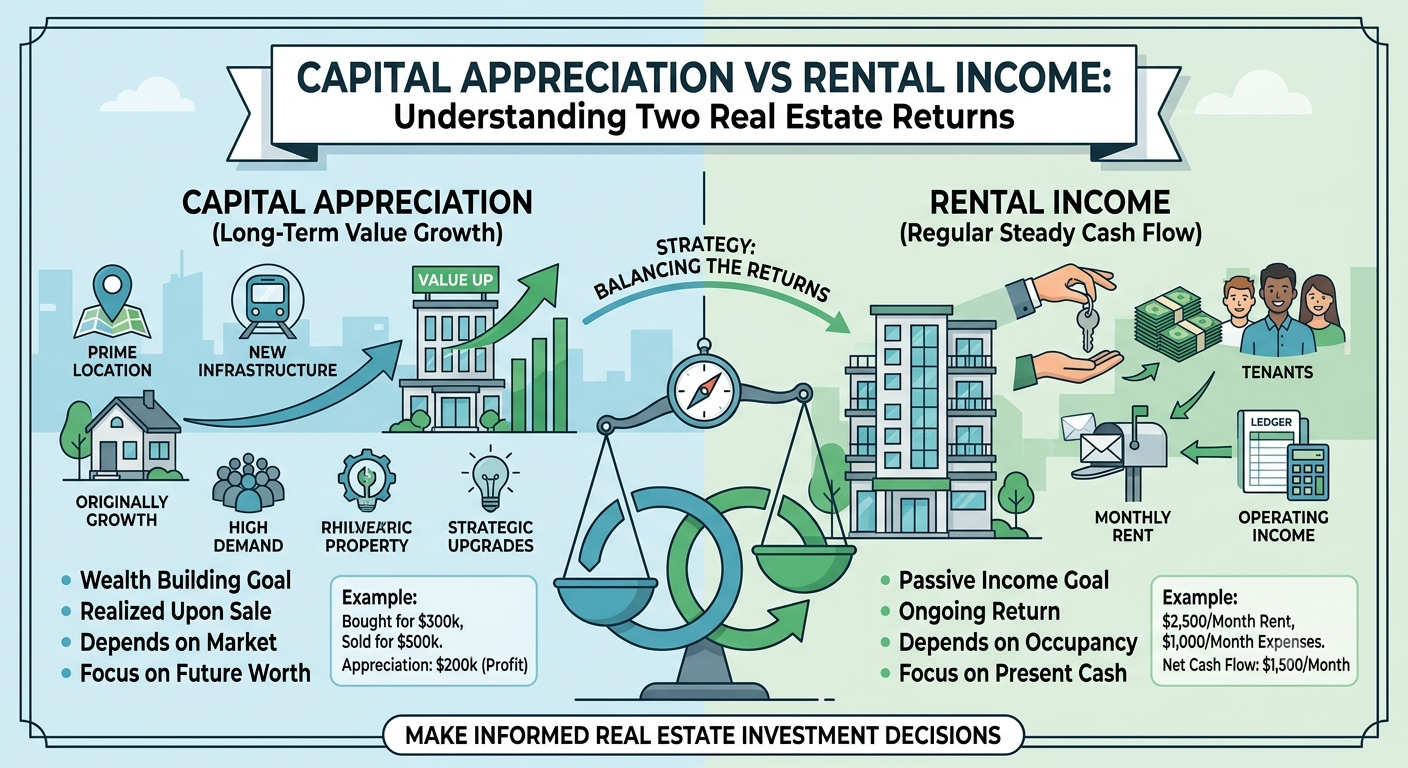
Real estate can generate returns in more than one way. Two of the most commonly discussed forms of real estate returns are capital appreciation and rental income.
Capital appreciation refers to the increase in a property’s value over time, while rental income is the regular income generated by leasing the property to tenants.
Understanding the difference between these two returns can help property buyers and investors evaluate opportunities according to their financial objectives.
What Is Capital Appreciation in Real Estate?
Capital appreciation is the increase in the market value of a property over a period of time.
For example, if a property is purchased for ₹60 lakh and its market value increases to ₹75 lakh after several years, the increase of ₹15 lakh represents capital appreciation.
Several factors can influence property appreciation, including:
- Location and connectivity
- Infrastructure development
- Demand and supply
- Employment opportunities
- Population growth
- Development of commercial areas
- Government infrastructure projects
- Social infrastructure such as schools and hospitals
- Overall economic conditions
However, property prices do not automatically increase every year. Appreciation depends on market conditions and the characteristics of the specific location and property.
What Is Rental Income?
Rental income is the money earned by leasing a property to a tenant.
For example, if a property is rented for ₹25,000 per month, the annual gross rental income would be:
₹25,000 × 12 = ₹3,00,000 per year
Rental income can provide recurring cash flow, but the actual return depends on expenses, vacancy periods, taxes, maintenance and other costs.
What Is Rental Yield?
Rental yield is commonly used to compare rental income with the property’s value.
A basic gross rental yield can be calculated as:
Gross Rental Yield = Annual Rental Income ÷ Property Value × 100
For example:
Property value = ₹60 lakh
Monthly rent = ₹25,000
Annual rent = ₹3 lakh
Gross rental yield:
₹3 lakh ÷ ₹60 lakh × 100 = 5%
This is a simplified calculation. Actual net returns may be lower after considering maintenance, vacancies, taxes and other expenses.
Capital Appreciation vs Rental Income
Both returns work differently.
| Factor | Capital Appreciation | Rental Income |
|---|---|---|
| Return type | Increase in property value | Recurring income |
| Time horizon | Usually medium to long term | Regular/ongoing |
| Cash flow | Generally realised when property is sold | Received during ownership |
| Key drivers | Location, demand, infrastructure and market conditions | Tenant demand, property type and local rental market |
| Liquidity | Usually lower than financial assets | Depends on property and rental demand |
| Expenses | Transaction and holding costs | Maintenance, vacancy, taxes and management costs |
| Main objective | Wealth creation through value growth | Regular cash flow |
Which Properties May Generate Rental Income?
Different property types can have different rental-demand profiles.
Residential Apartments
Residential apartments in established locations near employment hubs, schools, public transport and essential services may attract tenants looking for long-term accommodation.
Commercial Shops
Commercial properties can generate rental income when they are located in areas with suitable consumer demand, accessibility and business activity.
Office Spaces
Office properties may benefit from demand generated by businesses and professionals in established commercial districts.
Studio Apartments
Studios can appeal to students, working professionals, business travellers and other tenants depending on the location and surrounding infrastructure.
However, rental demand varies significantly between micro-markets, so investors should research actual local rents rather than relying solely on advertised figures.
What Drives Capital Appreciation?
Location is one of the most important considerations when assessing potential appreciation.
Areas experiencing improvements in:
- Road connectivity
- Metro or public transportation
- Airports
- Expressways
- Industrial development
- Commercial activity
- Employment opportunities
- Educational institutions
- Healthcare facilities
may experience changing property demand.
For example, an infrastructure project can improve accessibility to an area. However, investors should distinguish between announced, approved, under-construction and operational infrastructure, because the impact on property values can differ at each stage.
Can a Property Provide Both Returns?
Yes. A property can potentially generate both rental income and capital appreciation.
For example, an investor purchases a commercial property for ₹50 lakh.
If the property generates ₹2.5 lakh in annual gross rent and its market value later increases to ₹65 lakh, the investor has potentially received rental income during ownership while also benefiting from an increase in property value.
However, these returns are not guaranteed, and the property’s market value and rental income can change over time.
Factors to Check Before Investing
Before purchasing a property for returns, investors should evaluate several factors.
1. Location
Research connectivity, nearby infrastructure, employment centres, population growth and existing development.
2. Rental Demand
Look at actual rental transactions and comparable properties in the same micro-market.
3. Purchase Price
Compare the property’s total acquisition cost rather than only the quoted base price.
4. Vacancy Risk
A property may remain vacant between tenants. This can reduce actual rental returns.
5. Maintenance Costs
Maintenance, repairs, property management and other recurring expenses can reduce net rental income.
6. Resale Potential
Consider the availability of potential buyers and transaction activity in the local market.
7. Legal and Regulatory Checks
Verify ownership, approvals, applicable RERA details and other relevant documentation before making a substantial investment.
Common Mistakes Investors Should Avoid
Investors sometimes focus only on the expected return and overlook the risks associated with the property.
Some common mistakes include:
- Assuming property prices will always rise
- Calculating rental yield without considering vacancies
- Ignoring maintenance costs
- Relying only on future infrastructure announcements
- Not comparing nearby properties
- Ignoring legal documentation
- Buying solely because of a promotional offer
- Underestimating the time required to sell a property
A realistic evaluation should consider both potential returns and associated costs.
How to Compare Two Properties
Suppose you are comparing two properties.
Property A has a higher expected rental income but is located in a mature market with limited new infrastructure.
Property B has a lower current rental income but is located in an emerging area with significant development underway.
Instead of automatically choosing one, compare:
- Purchase price
- Current rental yield
- Vacancy levels
- Maintenance expenses
- Existing infrastructure
- Planned infrastructure
- Tenant demand
- Resale activity
- Developer track record
- Investment horizon