
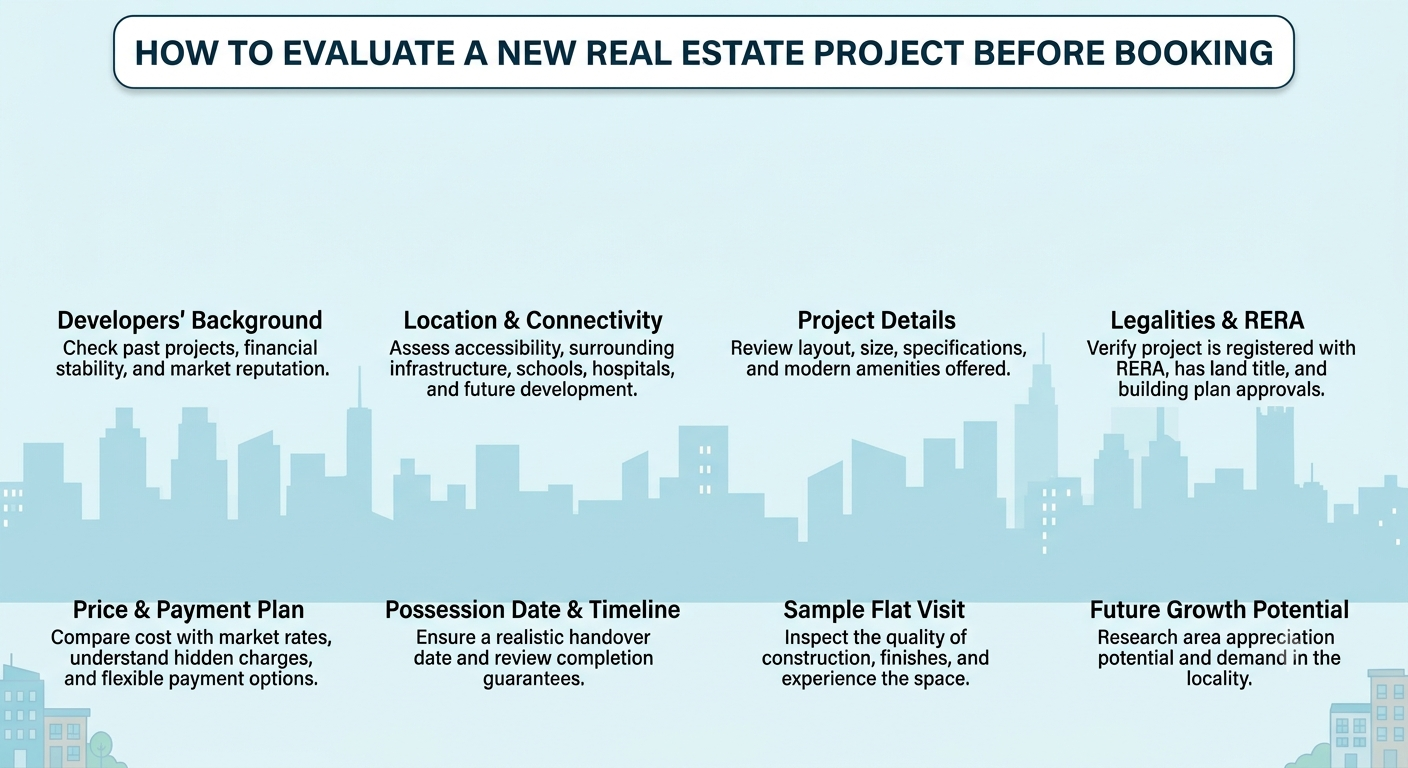
Buying a property is a major financial decision, especially when considering a newly launched or under-construction real estate project. Attractive prices, modern amenities, payment plans and future growth potential can make a project look appealing, but buyers should conduct proper research before making a booking.
Whether you are purchasing a home for personal use or considering property as an investment, evaluating the project carefully can help you make a more informed decision.
1. Check the Project’s RERA Registration
One of the first things a buyer should check is whether the project is registered with the relevant state Real Estate Regulatory Authority (RERA).
Verify the project’s RERA registration number and check the available project details, including:
- Promoter or developer details
- Project location
- Approved plans
- Proposed completion date
- Number of units
- Construction status
- Possession-related information
Do not rely only on brochures or advertisements. Verify important project information through official records wherever possible.
2. Research the Developer
The developer’s track record can provide useful information before booking a property.
Look at the developer’s previous projects and consider factors such as:
- Delivery history
- Construction quality
- Project approvals
- Customer reviews and experiences
- Quality of amenities
- Post-possession maintenance
- Legal or regulatory history
A single project should not be evaluated in isolation. Understanding the developer’s overall track record can give buyers additional context.
3. Evaluate the Location
Location plays an important role in both residential usability and long-term property demand.
Check the project’s connectivity with important destinations such as:
- Major highways and expressways
- Metro stations
- Airports
- Schools and colleges
- Hospitals
- Shopping and entertainment areas
- Employment hubs
- Upcoming infrastructure projects
Also consider the existing surroundings instead of focusing only on proposed developments. A location with improving connectivity and growing social infrastructure may have different prospects from an area that is still largely undeveloped.
4. Understand the Property Configuration and Carpet Area
Before booking, understand exactly what you are purchasing.
Compare the advertised size with the actual carpet area, built-up area and super built-up area, wherever applicable.
For apartments, buyers should also check:
- Number of bedrooms and bathrooms
- Balcony area
- Floor plan
- Floor location
- Apartment orientation
- Natural light and ventilation
- Parking allocation
For commercial properties, additional factors such as frontage, floor position, visibility, access and surrounding footfall may be important.
5. Compare the Total Cost, Not Just the Base Price
A property advertised at an attractive base price may have several additional costs.
Ask for a detailed cost sheet covering applicable charges such as:
- Base property price
- Preferential location charges
- Floor-rise charges
- Parking charges
- Club or amenity charges
- Maintenance-related charges
- Infrastructure or development charges
- Applicable taxes and government charges
- Registration and stamp duty
Understanding the complete acquisition cost makes it easier to compare different projects accurately.
6. Study the Payment Plan
New projects often come with different payment structures.
Before choosing a payment plan, understand:
- Booking amount
- Down payment requirements
- Construction-linked payments
- Time-linked instalments
- Loan disbursement requirements
- Possession-related payments
- Cancellation terms
- Delayed payment charges
Choose a payment structure that fits your financial capacity rather than making a decision based solely on a promotional offer.
7. Verify Approvals and Legal Documents
A buyer should understand the legal status of the property before making a substantial payment.
Depending on the project, relevant documents may include:
- Land title documents
- Development or collaboration agreements
- Approved building plans
- RERA registration
- Necessary permissions and approvals
- Encumbrance-related information
- Allotment documents
- Agreement for Sale
For significant investments, consulting a qualified property lawyer for document verification can be a prudent step.
8. Visit the Project Site
Never evaluate a property only through digital advertisements, brochures or sample images.
Visit the actual project location and observe:
- Construction progress
- Road connectivity
- Surrounding development
- Nearby properties
- Traffic and accessibility
- Existing infrastructure
- Noise levels
- Drainage and water-related conditions
- Actual views and surroundings
A site visit can reveal practical details that may not be obvious from marketing material.
9. Compare Amenities With Actual Requirements
Modern projects may offer clubhouses, swimming pools, gyms, landscaped gardens, sports facilities and other amenities.
However, buyers should look beyond the number of amenities.
Ask:
Will these facilities actually add value to my lifestyle or investment objective?
Also check whether the amenities are proposed, under construction or already operational, and whether any additional charges apply.
10. Understand Possession and Construction Timelines
For an under-construction project, carefully review the stated completion and possession timelines.
Do not make a decision solely on verbal assurances. Check the information available in the project’s official documentation and RERA records.
Also understand the agreement terms related to:
- Possession
- Construction delays
- Compensation or applicable remedies
- Cancellation
- Refund provisions
11. Compare the Project With Nearby Options
Before booking, shortlist a few comparable projects in the same micro-market.
Compare them based on:
| Factor | What to Compare |
|---|---|
| Location | Connectivity and surrounding development |
| Price | Total acquisition cost |
| Size | Carpet area and usable space |
| Developer | Track record |
| RERA | Registration and project details |
| Possession | Stated timeline |
| Amenities | Quality and relevance |
| Maintenance | Expected long-term costs |
| Resale | Existing market activity |
| Rental | Local rental demand |
This comparison can help you understand whether the project fits your requirements and budget.
12. Consider the Investment Objective
A property purchased for self-use should be evaluated differently from an investment property.
For a homebuyer, factors such as schools, hospitals, commute, layout and lifestyle may be particularly important.
For an investor, additional factors may include:
- Rental demand
- Rental yield
- Capital appreciation potential
- Liquidity
- Local employment growth
- Infrastructure development
- Future supply
- Resale demand
There is no single factor that determines whether a property is suitable. The evaluation should match the buyer’s specific objective.
Final Checklist Before Booking
Before paying the booking amount, make sure you have reviewed:
☑ RERA registration
☑ Developer background
☑ Project location
☑ Carpet area and floor plan
☑ Complete cost sheet
☑ Payment plan
☑ Legal documents
☑ Project approvals
☑ Construction status
☑ Possession timeline
☑ Amenities and maintenance
☑ Nearby competing projects
☑ Your financing capacity
☑ Agreement terms